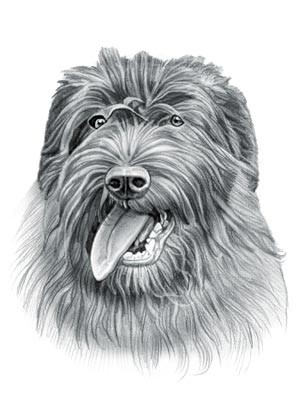
Bouvier Des Flandres Characteristics: The faithful and watchful Bouvier Des Flandres is a breed of large dog classified as a member of the Herding Dog Group. The Bouvier Des Flandres, is characterized by its rugged appearance with a bearded and mustached head and an alert, resolute expression. Other characteristics include dark brown, oval-shaped, black rimmed eyes; high set, rough coated ears; a a short, broad body and a bold, fluid gait. The temperament of the Bouvier Des Flandres can be described as Loyal, Gentle, Protective. The coat type of the Bouvier Des Flandres is described as thick double coat in assorted colors. Due to its characteristics and qualities, the Bouvier Des Flandres demonstrated the desired traits of a Watch dog and Farm Dog and is known by its nick name the "Strong Guy". The origin of the Bouvier Des Flandres dog breed was in Belgium where it was developed in the 1600's. Fast Facts about the Bouvier Des Flandres: The following facts provide fast information about the Bouvier Des Flandres breed. Size: Large *** Breed Group: Herding Dog Group *** Nick name: "Strong Guy" *** Origin: Belgium *** Male Height: 24-27 inches (62-68 cm) *** Female Height: 23-26 inches (59-65 cm) *** Male Weight: 77-88 lbs (35-40 kg) *** Female Weight: 60-77 lbs (27-35 kg) *** Coat Type: thick double coat *** Coat Colors: assorted colors *** Litter Size: 5 - 10 puppies *** Health Problems: Bloating, Eye problems, Hip dysplasia *** Lifespan: 10 - 12 years *** Hypoallergenic: Yes Bouvier Des Flandres Breed Group and Dog Type - Herding Dog Group: The Bouvier Des Flandres is one of the many breeds of dogs that belong to the Herding Dog Group. The Bouvier des Flandres was officially recognized by the American Kennel Club (AKC) in 1931. Other names for the Bouvier Des Flandres: The Bouvier Des Flandres is known by the nickname of the "Strong Guy". Other names for this breed of dog include the Flanders Cattle Dog and Vlaamse Koehond. Origin of the name: The origin of the name "Bouvier Des Flandres" derives from the French word 'Bouvier' meaning a drover or a cattle dog. 'Des Flandres' meaning "of Flanders" referring to the Flemish Region of northern Belgium Bouvier Des Flandres History and Origin: The country of origin of the Bouvier Des Flandres breed was in the Flemish region of Flanders in Belgium during the 1600's. The Bouvier Des Flandres was developed in Belgium and northern France for herding, guarding, and driving cattle. During the Middle Ages Flanders extended their agricultural lands and meadows by draining the marshlands and evolved strong and heavy breeds of cattle. The farmers and drovers used the power and strength of the Bouvier Des Flandres to help them drive the cattle. The Bouvier Des Flandres was a highly versatile dog and the Flemish farmers used the dog not only to herd cattle but also as a guard dog, watch dog and cart dog, moving both people and products as a convenient and inexpensive alternative to the horse. The Bouvier Des Flandres was also used on the Flemish farms to churn butter. Churning butter is an arduous task and treadmills were designed so that a dog could do the hard work. The Belgium army capitalized on the versatility of the Bouvier Des Flandres during WW1 (1914 - 1918) when the dog was used to locate the wounded and carry messages, through the gunfire and shelling of the battle fields. The courageous Bouvier Des Flandres was also used as a ratter in the trenches. Flanders was devastated by the fighting during the war and the Bouvier Des Flandres breed was on the verge of extinction. The breed was saved by dog breeders who worked to revive the Bouvier des Flandres and their successful breeding program led to the dog being introduced to the United States and European countries in the 1920's. Another role was found for the Bouvier Des Flandres during WW2 (1939 - 1942) when its keen scenting ability was used to sniff out ammunition dumps and land mines. Bouvier Des Flandres History - The White House: In December 1984 a Bouvier des Flandres puppy called "Lucky" was given to Nancy Reagan. Lucky was one of the largest dogs to live at the White House but as the puppy became older it became boisterous and was photographed dragging President Ronald Reagan. This did not give the impression of the leader of the western world being in control and Lucky was transferred to the Reagan's ranch, the Rancho del Cielo, in Santa Barbara, California. Lucky the Bouvier Des Flandres was replaced by a more manageable English Toy Spaniel called Rex. Bouvier Des Flandres Modern History: The modern history of the Bouvier Des Flandres moved on and the breed is now used by the military and the police but it is also valued as a guide and guard dog, therapy dog and a family pet. Bouvier Des Flandres Height: The Bouvier Des Flandres breed is classified as a large sized dog. The height to the shoulder of a male dog is 24-27 inches (62-68 cm). The height to the shoulder of a female dog is 23-26 inches (59-65 cm). Bouvier Des Flandres Weight: Not surprisingly for a large sized dog, the weight of a Bouvier Des Flandres male dog is 77-88 lbs (35-40 kg). The weight of the smaller female dog is 60-77 lbs (27-35 kg). Bouvier Des Flandres Coat Type - LOW shedding coat: The coat type is of the Bouvier Des Flandres is described as thick double coat. Bouvier Des Flandres Coat Colors: The colors of this dog breed consist of assorted colors consisting of Gray, Fawn, Brindle, Salt & Pepper and Black & Brown. (N.B. Brindle is a brownish or tawny color). Bouvier Des Flandres Grooming - MODERATE Grooming Needs: The dog grooming needs of the Bouvier Des Flandres is not extensive and therefore categorized as Moderate in order to maintain a healthy coat, reducing the risk of skin infections. The modest grooming needs of the Bouvier Des Flandres is considered to be mid-maintenance requiring weekly brushing and combing. Dog Grooming Requirements should include bathing the dog on a monthly basis and making regular inspections of the teeth, eyes, nails and ears. Bouvier Des Flandres Litter Size: The litter size of this dog breed ranges from 5 - 10 puppies. Bouvier Des Flandres puppies for sale can be obtained reputable breeders and from rescue centers. The cost of Bouvier Des Flandres puppies varies depending on location, pedigree history and the dog breeder. Bouvier Des Flandres Temperament and personality: The temperament and personality of the popular Bouvier Des Flandres dog breed is described as Faithful, Loyal, Gentle, Protective and Watchful. Bouvier Des Flandres Exercise Requirements - HIGH Exercise Requirements: The exercise requirements of this breed of dog is high. The Bouvier Des Flandres requires regular daily exercise consisting of approximately one to two hours each day. This large, powerful dog has a fast, bold, fluid gait with strides of a moderate length and requires a brisk walking speed or jogging by the owner to meet the dogs exercise requirements. Bouvier Des Flandres Diet: A fully grown Bouvier Des Flandres should be fed twice a day. A diet consisting of a premium dog food can be balanced with fresh food eaten by the family. The question is What Can Dogs Eat?. Check out our comprehensive list of what dogs can and what dogs cannot eat. Bouvier Des Flandres Health Problems: Potential health problems of the Bouvier Des Flandres breed include Bloating, Eye problems, Hip dysplasia. Resolving health problems can prove to be expensive and it is always wise to obtain pet insurance or dog health insurance when buying a dog. Is the Bouvier Des Flandres dog breed said to be Hypoallergenic? Answer: Yes (Refer to Hypoallergenic Dogs). Bouvier Des Flandres Lifespan: The life expectancy of dogs vary according to the size, breed of dog and any serious health problems. The typical lifespan of the Bouvier Des Flandres breed is 10 - 12 years. Bouvier Des Flandres Male Dog Names: Male Dog names are most often chosen to reflect favorite names of the owner or the strength, size, coloring and country of origin of the Bouvier Des Flandres breed. To give you some inspiration regarding good male Bouvier Des Flandres names our small selection might be of help with naming boy dogs. Our top male dog names are: D'anton *** Gaspard *** Napoleon *** Max *** Buddy *** Jake *** Rocky *** Gideon *** Jesse *** Gerrard *** Dareau. Bouvier Des Flandres Female Dog Names: Female Dog names tend to be softer, prettier and reflect the temperament of the Bouvier Des Flandres girl dog. Our top choice of good female Bouvier Des Flandres names are Renee *** Richelle *** Joelle *** Roxy *** Missy *** Brandy *** Coco *** Gracie *** Sammy *** Lisette *** Suzette. Fast Facts about the Bouvier Des Flandres: The following facts provide fast information about the Bouvier Des Flandres breed. Scientific name: Canis lupus familiaris *** Dog Breed Group: Herding Dog Group *** Size: Large *** Country of Origin: Belgium *** History / Date: 1600's *** Male Bouvier Des Flandres Height: 24-27 inches (62-68 cm) *** Male Bouvier Des Flandres Weight: 77-88 lbs (35-40 kg) *** Coat Type: thick double coat *** Litter Size: 5 - 10 puppies *** Bouvier Des Flandres Health Problems: Hip dysplasia, thyroid, and joint problems *** Bouvier Des Flandres Lifespan: 10 - 12 years *** |