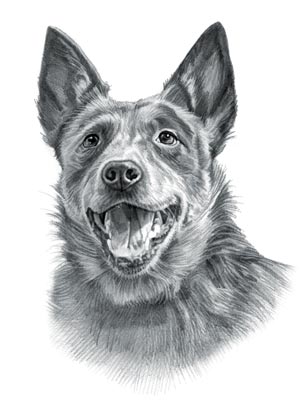
Australian Cattle Dog Characteristics: The highly intelligent, spirited and vigilant Australian Cattle Dog is a medium sized breed, classified as a member of the Herding Dog Group (AKC:1980). The Australian Cattle Dog, is characterized by its substantial, compact appearance with a broad head, black muzzle, somewhat aggressive expression, and a powerful, tireless gait. Other characteristics include a strong, level back, medium sized, oval shaped eyes and pricked, medium sized ears. The temperament of the Australian Cattle Dog can be described as Energetic, Protective, Alert. The coat type of the Australian Cattle Dog is described as short, weather-resistant coat in assorted colors. Due to its characteristics and qualities, the Australian Cattle Dog demonstrated the desired traits of a Watchdog, Herder and Dover, known by its nick name the "Heeler". The origin of the Australian Cattle Dog breed was in Australia where it was developed in the 1800's. The Australian Cattle Dog ranks as number 10 in the list of the smartest dogs. Fast Facts about the Australian Cattle Dog: The following facts provide fast information about the Australian Cattle Dogs breed. Size: Medium *** Breed Group: Herding Dog Group (AKC:1980) *** Nick name: "Heeler" *** Origin: Australia *** Male Height: 17 - 20 inches (43 - 51 cm) *** Female Height: 17 - 19 inches (43 - 48 cm) *** Male Weight: 30 - 62 pounds (13 - 28 kg) *** Female Weight: 30 - 62 pounds (13 - 28 kg) *** Coat Type: short, weather-resistant coat *** Coat Colors: assorted colors *** Litter Size: 1-7 puppies *** Health Problems: Deafness, Eye problems, Hip Dysplasia *** Lifespan: 12-15 years *** Hypoallergenic: No Australian Cattle Dog Breed Group and Dog Type - Herding Dog Group (AKC:1980): The Australian Cattle Dog is one of the many breeds of dogs that belong to the Herding Dogs Group (AKC:1980). Other names for the Australian Cattle Dog: The Australian Cattle Dog is known by the nickname of the "Heeler". Other names for this breed include the ACD, Australian Heeler, Blue Heeler, Australian Cattledog, and the Queensland Heeler. Origin of the name: The origin of the name "Australian Cattle Dog" derives from the dog's country of origin in Australia and its main role as a cattle drover. Australian Cattle Dog History and Origin: The country of origin of the Australian Cattle Dog breed was in Australia during the 1800's. The ancestor of the breed is believed to be the Smithfield Collie who was used for droving cattle in the south-east of England to the Smithfield Meat Market in London. The explorer James Cook claimed Australia for the British Crown in 1770 and the colonization of Australia began. Free settlers began to immigrate to Australia attracted by the prospect of free land grants. In the early 1800's the first cattle were exported to Australia as there were no native animals suitable for domestication. The Australian cattle men needed a tough, agile working dogs like the Collie to help them herd the wild cattle in the intense heat, across the rough, unfenced terrain of Australia. However, the Collie was a noisy dog and its bark unsettled the cattle on the big cattle stations. Australian Cattle Dog History - The Timmins Biters: In the 1830s a contract drover named Jack Timmins crossed some collies with the indigenous, wild Dingo. The Australian Aborigines had achieved some success domesticating the Dingo and Jack Timmins experimented with retaining the qualities of the Collie with the resilience and stamina of the Dingo. The most important characteristic of the Dingo is that their bark is short and rarely used. The result of Jack Timmins experiment was a much quieter, but a far more headstrong and aggressive breed, that was given the name of "Timmins Biters". Australian Cattle Dog History - Halls Heelers: The "Timmins Biters" was unsuitable for herding cattle and in 1840 a ranch owner in New South Wales called Thomas Hall decided to cross his blue merle Collies with the Dingo. His attempts resulted in dogs that were given the name of the "Hall's Heeler". The word "heeler" referred to the dog's tendency to drive cattle by nipping at their heels. Australian Cattle Dog History - The Blue Heelers: The Although "Hall's Heelers were quite successful two brothers, Jack and Harry Bagust, believed that they could make further improvements. They crossed the "Blue Heeler" with a Dalmatian, hoping to increase the sociability with drover's horses and brought a Bull Terrier into their breeding program to increase the dog's ability as a guarddog. The experiment failed as it was found that some of the working ability of the dog was lost. The Bagust brothers then experimented in crossing their blue merle dogs with the Kelpie to restore the dog's working ability. The experiment was a success and the dogs were given the name "Blue Heelers". The Australian Cattle Dog: The crossbreeding that produced the Blue Heeler resulted in a variety of qualities. The Blue Heeler had the blue-merle coloring of its ancestors, the strong herding instincts of the Collie, the ability to work with horses from the Dalmation and the tough resilience and quietness of the dingo. The Blue Heeler was renamed as the Australian Heeler as the breed finally became established in the 1890s. In 1903 the standard was endorsed by the Cattle and SheepDog Club of Australia and was eventually given its modern name - the Australian Cattle Dog. Australian Cattle Dogs were officially recognized by the American Kennel Club (AKC) in 1980. The Australian Cattle Dog continue their work to the present day as an invaluable all-purpose farm and ranch dog. The hardy, agile Australian Cattle Dog has also become popular as a family pet, but the breed is naturally suspicious of strangers. Australian Cattle Dog Height: The Australian Cattle Dog breed is classified as a medium sized dog. The height to the shoulder of a male dog is 17 - 20 inches (43 - 51 cm). The height to the shoulder of a female dog is 17 - 19 inches (43 - 48 cm). Australian Cattle Dog Weight: The weight of the male in this medium sized dog is 30 - 62 pounds (13 - 28 kg). The weight of the smaller female is 30 - 62 pounds (13 - 28 kg). Australian Cattle Dog Coat Type: The coat type is described as double coated with short, weather-resistant coat. Australian Cattle Dog Coat Colors: The colors of this breed consist of a blue or red mottled coat with black, blue, or tan markings. N.B. The word "Blue" is used to describe a cool-toned, metallic gray color. The term "Red" refers to reddish shades of orange, brown, and tan colors. Australian Cattle Dog Grooming - LOW Grooming Needs: The grooming needs of the Australian Cattle Dog are categorized as Low in order to maintain a healthy coat and reduce the risk of skin infections. The limited dog grooming needs of the Australian Cattle Dog are therefore considered to be low maintenance, requiring limited attention to grooming with casual brushing and combing. Grooming needs should also include bathing on a monthly basis and making regular inspections of the eyes, ears, nails and teeth. Australian Cattle Dog Litter Size: The litter size of this dog breed ranges from 1-7 puppies. Australian Cattle Dog puppies for sale can be obtained reputable breeders and from rescue centers. The cost of Australian Cattle Dog puppies varies depending on location, pedigree history and the breeder. Australian Cattle Dog Temperament and personality: The temperament and personality of this popular dog breed is described as Spirited, Energetic, Protective, Alert and Vigilant. Australian Cattle Dogs Exercise Requirements - HIGH Exercise Requirements: The exercise requirements of this breed of dog is high. The Australian Cattle Dog requires regular daily exercise consisting of about two hours every day. This medium sized dog has a powerful, tireless gait with strides of a moderate length requiring a steady walking or jogging speed by the owner to meet the dogs exercise requirements. If the dog has more energy than you do, then teach your dog to play ball in a chase and catch game. Australian Cattle Dogs Diet: A fully grown Australian Cattle Dog should be fed twice a day. A diet consisting of a premium dog food can be balanced with fresh food eaten by the family. The question is What Can Dogs Eat?. Check out our comprehensive list of what dogs can and what dogs cannot eat. Australian Cattle Dog Health Problems: Potential health problems of the Australian Cattle Dog breed include Deafness, Eye problems, Hip Dysplasia . Resolving health problems can prove to be expensive and it is always wise to obtain pet insurance or health insurance when buying a puppy. Is the Australian Cattle Dog breed said to be Hypoallergenic? Answer: No. Australian Cattle Dogs Lifespan: The life expectancy of dogs vary according to the size, breed of dog and any serious health problems. The typical lifespan of the Australian Cattle Dogs is 12-15 years. Australian Cattle Dogs Male Names: Male names are most often chosen to reflect favorite names of the owner or the strength, size, coloring and country of origin of the Australian Cattle Dogs. To give you some inspiration regarding good male Australian Cattle Dog names our small selection might be of help with naming boy dogs. Our top male dog names for the Australian Cattle Dog are: Bluey *** Ragnor *** Rave *** Tempest *** Victor *** Wolf *** Buster *** Cody *** Alex *** Baruch. Australian Cattle Dog Female Names: Female names tend to be softer, prettier and reflect the temperament of the Australian Cattle Dog girl dog. Our top choice of good female Australian Cattle Dogs names are Bella *** Cinder *** Jez *** Kaige *** Luna *** Mayze *** Velvet *** Willow *** Zurie *** Abby. Fast Facts about the Australian Cattle Dog: The following facts provide fast information about the Australian Cattle Dog breed. Scientific name: Canis lupus familiaris *** Dog Breed Group: Herding Dogs Group (AKC:1980) *** Size: Medium *** Country of Origin: Australia *** History / Date: 1800's *** Male Australian Cattle Dogs Height: 17 - 20 inches (43 - 51 cm) *** Male Australian Cattle Dogs Weight: 30 - 62 pounds (13 - 28 kg) *** Coat Type: short, weather-resistant coat *** Litter Size: 1-7 puppies *** Australian Cattle Dogs Health Problems: Hip dysplasia, thyroid, and joint problems *** Australian Cattle Dogs Lifespan: 12-15 years *** |